More Media Consolidation is Bad News for Journalism, TNG-CWA Tells FCC
Advocating for media diversity, good jobs and the survival of quality journalism, TNG-CWA President Bernie Lunzer cautioned the FCC this week against lifting what's left of the ban on cross-ownership of a community's newspapers and broadcast media.
Merging newsrooms and sharing content among once-independent papers, radio and TV stations and now Internet sites does not serve the public, Lunzer said, testifying at an FCC hearing in Tampa, Fla. Similar to what's happening in many markets, one company already controls a third of Tampa's media and collectively four companies control 73 percent of it.
"Most consolidations are being done for efficiencies and that means less content, fewer journalists and less diversity in both content and staff," Lunzer said.
He said Guild members understand better than anyone that their industry and their jobs are changing, and have embraced high-tech training and efforts to find new ways to fund newspapers and news-gathering operations.
"Experimenting with mixtures of media, like those being discussed here today, is important," Lunzer said. "But if all the FCC does is lift the cross-ownership ban entirely, it will have done nothing to preserve or promote quality information. In fact, it will speed up the demise of journalism while preserving a cash flow for some."
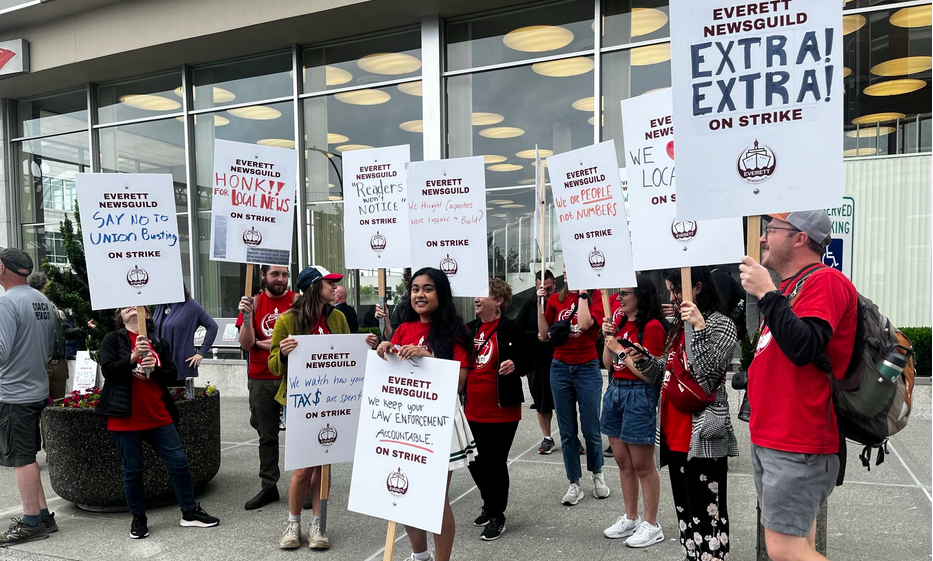
(Text and photo swiped from CWA e-newsletter.)
7 Responses »
Leave a Response
Entries(RSS)
Methinks Bernie is fighting the 20th century battle in the 21st century media landscape. What the FCC does or does not do will have little impact on the development of new forms of media. You need to stop thinking about how to prop up old media companies and start focusing on reinventing EVERYTHING.
End of sermon.
Agree with Curt. But why stop there? Speaking of propping up old media companies, it's time to rethink propping up old union structures that no longer conform to the landscape. IE, can anyone with a straight face still argue we can afford the redundancy of a TNG international? Waiting anxiously for that international per-cap dues reduction Bernie virtually promised last year.
We'd be in a world of hurt without the international. Especially since starting here in the office, I've made ample use of the staff's knowledge and expertise, and we've gotten great advice. Maybe in the past, our staffs and officers were just so darn groovy we didn't need anything from them but that certainly isn't where we are now.
I appreciate the expertise of the INternational more than most people. But it's not an either-or proposition. Nobody is suggesting going it alone. If we were a locally organized CWA chapter, the chain of command would lead directly to a larger international, arguably with even more expertise and means. Note that I said arguably. The prospect of being lost in the shuffle is probably quite real. But I think extreme times call for creative measures. For years, we've heard that there were good reasons to maintain an entire (expensive) TNG international union structure back east that focuses on newspaper journalists. With the reduced numbers of same, I question whether that still holds true. And if the international does wish to justify its continued existence, a good way to do so would be aggressive recruitment of other non-newspaper clerical and communications workers to reestablish solid ranks.
Oh. CWA already does that?
I rest my case.
Does anyone else think the matter is at least worth exploring? Every other portion of our industry has been forced to think creatively and steamline. Our union, at the international level, should follow suit.
The Guild International's staff is a LOT smaller than it was just 10 years ago, and they're also looking at some efficiencies with the other media sectors. Any changes there would have to also be approved by those other sectors, but there's some talking going on.
The chain from a standard CWA local doesn't lead to the CWA HQ staff in D.C., but rather to the District 7 staff (based in Denver, but with a satellite office in Kent). There are a lot of things CWA staffers do well, but many of them don't have the kind of bargaining experience that our Guild staff do because a lot of the workers have been under those huge phone-company contracts. They probably have more grievance-handling experience, because of the nature of some of the work and workplaces.
I agree that we need to do more organizing. We need members who are willing to step away from their newspaper jobs for a little while to do that. It's a hard thing for a lot of people to do right now, I think.
Thanks for that insight, Yoko. But if the Guild international staff is a lot smaller (I'd like to see the numbers), why do the per-capita dues we pay to them continue go up every year, including each of the last 10 years? (I know, the constitution has a formula based on "average minimum" pay levels in contracts. The formula is a joke and needs to be thrown out and replaced with a formula tied to what people actually are PAID. Can anyone argue with a straight face that newspaper workers' pay has increased in the past decade?)
The CWA reporting structure makes more sense. You have people in Kent you can look in the eye, people in Denver at District 7 close at hand -- not people in an office no one ever sees in Washinton DC. Union people need to rediscover the fact that real union power is LOCAL. We're better off affilliated with machinsts and clerical workers and cable/phone workers in a regional structure than with a handful of old newspaper unions scattered around North America. It makes no sense. Regional union coops have the ability to apply pressure within a region. Union dues dollars should stay in that region to pay people we know and trust. Yes, that's a bigger-picture vision that's a bit off topic. But I make the point to suggest that maybe it's worth small steps in that direction, even within our CWA union structure.
Building closer local ties is one of the reasons we're talking with CWA 7800 about moving our local offices into a shared space. (The other big reason is cost.)
As a local, we're quite dependent on the fortunes of the Times; they have the same situation with Qwest (and Qwest's decisions on where to base their work). Learning more about each other seems a prudent thing to do in case of any future crises on those fronts.